The Freeze Index: What Share of a Provider’s Complaints Is About a Frozen or Closed Account
The Freeze Index measures what a provider’s complaints are made of, and how many arrive per 1,000 accounts where a regulator publishes that denominator. Nobody publishes how often accounts are actually frozen, so this is the closest measurable thing.
In the United States, more than half of the complaints filed against Mercury Technologies are about money not being available or an account being closed, against roughly a quarter for TransferWise Ltd. In the United Kingdom, Starling Bank receives fewer complaints in absolute terms than Monzo Bank but more per 1,000 accounts. Those are two different measurements from two regulators, and they cannot be added together.
What the Freeze Index counts, and what it does not
A raw complaint count ranks customer bases. PayPal collects about 135 times the complaints Novo does, 16,548 against 123, and that comparison mostly measures how many customers each one has.
This index uses a different number in each country, because the two regulators publish different things.
In the United States it uses a share: out of every 100 complaints filed against a provider, how many are about money not being available or an account being closed. A share is internal to the provider, so it needs no customer count, and customer counts are the figure nobody publishes in a form you can check.
In the United Kingdom it uses the denominator the regulator itself publishes: complaints per 1,000 accounts, reported by the firms to the Financial Conduct Authority and published by the FCA.
Four complaint labels from the CFPB Consumer Complaint Database are counted as a freeze, using the database’s own wording: Money was not available when promised, Closing an account, Closing your account, and Trouble accessing funds in your mobile or digital wallet.
Two labels are deliberately excluded. Fraud or scam describes a customer defrauded by a third party, which is a different event from a provider withholding money. Managing an account covers everything from a failed login to a demagnetised card, and a category that covers everything measures nothing.
The four labels are published here so you can rebuild the count with a definition of your own. That is what makes this a method rather than a verdict.
United States: the share of complaints about money not available or a closed account
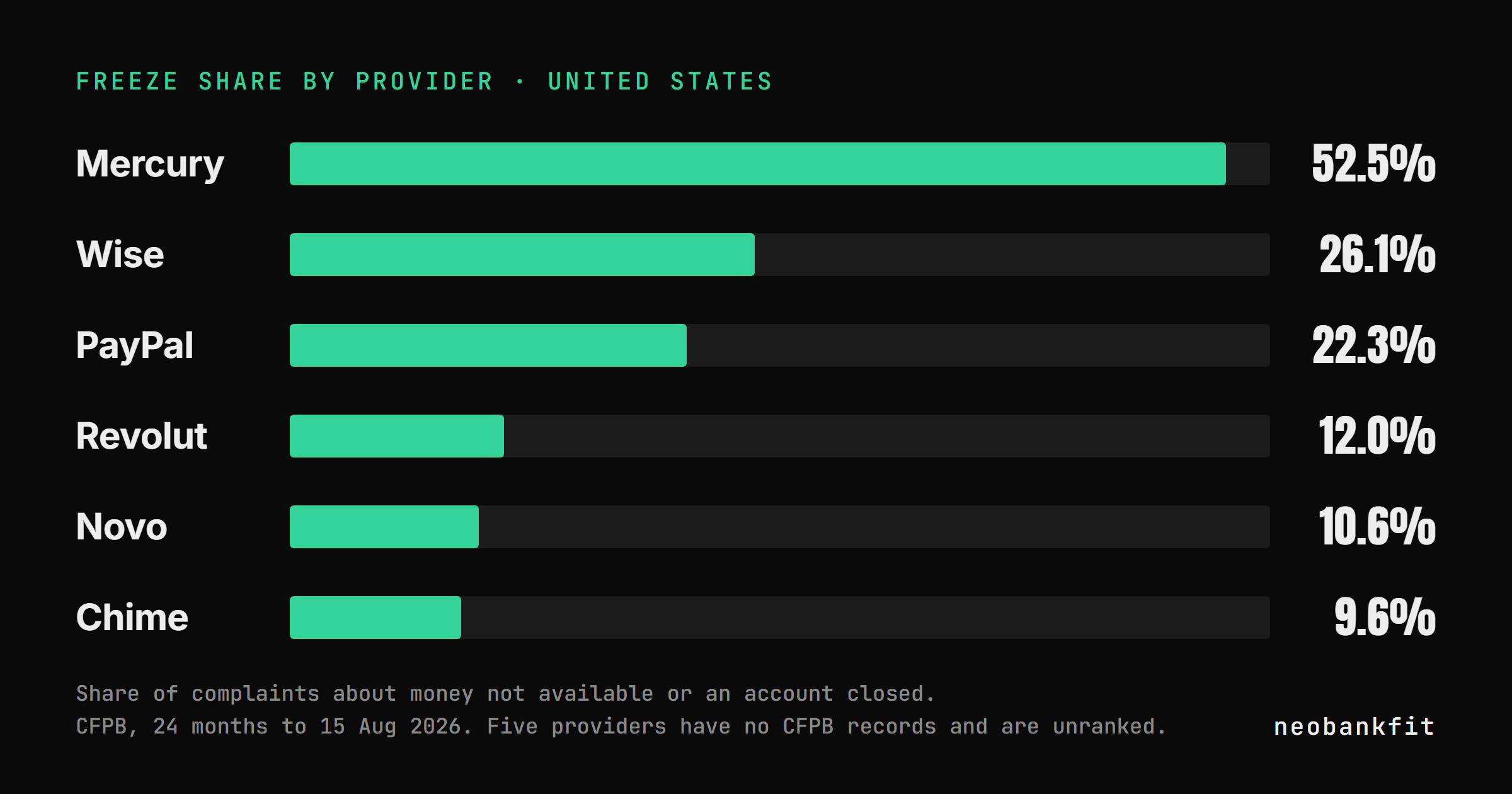
Source: the CFPB Consumer Complaint Database, complaints filed in the 24 months to 15 August 2026, read on 15 August 2026. The entity queried is named in each row, because the count is only reproducible against the exact company string.
| Provider | Entity queried | Freeze share | Freeze complaints | Total |
|---|---|---|---|---|
| Mercury | Mercury Technologies, Inc. | 52.5% | 105 | 200 |
| Wise | TransferWise Ltd | 26.1% | 249 | 954 |
| PayPal | Paypal Holdings, Inc | 22.3% | 3,696 | 16,548 |
| Revolut | Revolut Technologies Inc. | 12.0% | 32 | 267 |
| Novo | Novo Platform Inc. | 10.6% | 13 | 123 |
| Chime | Chime Financial Inc + Chime Inc. | 9.6% | 1,642 | 17,154 |
| N26 | N26 Inc. | base too small | 1 | 2 |
| Monzo, Starling, bunq, Payoneer, Airwallex | not in the database | n/d | n/d | n/d |
Chime is counted across two company strings. Searching Mercury also returns Mercury Financial Intermediate LLC, a credit card issuer and a separate company, which is not counted here.
Mercury Technologies carries the panel: more than one complaint in two is about money not being available or an account being closed, and the most frequent single label is Closing an account, with 96 of the 200 complaints. Mercury also has the smallest complaint base among the six providers with a share, which is why the share is the honest way to read it. The 200 tells you Mercury is smaller than Chime. The 52.5% tells you what those 200 complaints are about.
A share describes composition, not frequency. It does not say Mercury Technologies freezes more accounts than Chime does. It says that when a Mercury customer files a complaint with the CFPB, the subject is far more likely to be a blocked or closed account.
The counter moves. A re-read on 17 August 2026 returned the same shares to one decimal place but different totals, two days later. This page publishes one reading date for the whole table and keeps it, so the table never mixes figures from different days.
The two rows that need explaining
N26 has a row and no share, because N26 left the United States market. N26 Inc. has 90 complaints on record and 2 in the last 24 months. A provider that stops operating stops collecting complaints.
Monzo, Starling, bunq, Payoneer and Airwallex are marked n/d, and n/d is not zero. They have no records in the CFPB database, which covers United States consumer complaints. Their absence measures the perimeter of the database, and this page keeps them out of the ranking instead of giving them a low score.
United Kingdom: complaints per 1,000 accounts, the denominator the regulator publishes
Source: FCA firm-level complaints data, publication labelled 2025 H2, product group Banking and credit cards, file downloaded on 15 August 2026. The window the firms declare in the file is not the one the label suggests, and the third limit below gives both dates.
| Firm | Complaints per 1,000 accounts | Upheld by the firm | Complaints opened |
|---|---|---|---|
| Starling Bank Limited | 3.62 | 41.0% | 17,323 |
| Zempler Bank Limited | 3.05 | 43.0% | 1,519 |
| Monzo Bank Ltd | 2.07 | 29.9% | 49,247 |
The biggest number in the table belongs to the firm with the lowest rate per 1,000 accounts. Monzo Bank Ltd opened 49,247 complaints in the period, almost three times Starling Bank Limited’s 17,323. Per 1,000 accounts, Monzo is at 2.07 and Starling is at 3.62. Ranking by the absolute figure puts Monzo last of the three, while the per-account figure gives it the lowest rate of the three.
The upheld column records how often each firm agreed with its own customer, so Starling’s 41.0% against Monzo’s 29.9% is the firm’s judgement of itself rather than an independent one. The independent judgement belongs to the Financial Ombudsman Service, a separate source that is not in this version of the index. If your complaint has reached that stage, here is how escalating a frozen account to the Financial Ombudsman works.
Three limits belong next to this table.
Wise, Revolut, N26 and Payoneer are not in this file. Checked sheet by sheet. The file records who reported, not why anyone is missing, so this page states the absence and stops there. The same n/d rule applies as in the United States panel.
The reporting threshold cuts the table before it starts. Firms reporting fewer than 500 complaints in six months, or fewer than 1,000 in a year, do not appear at all.
The window is not what the label suggests. The three firms above all declare 1 April 2025 to 30 September 2025 in the file’s own reporting period column, while the FCA page describes the publication as covering 1 July to 31 December 2025. Where the two disagree, this page follows the file.
What decides which regulator ever sees your complaint is the licence behind the account. That is covered in the difference between a neobank, an EMI and a bank, and in what happens to your money when a neobank freezes it.
Italy: where the number is published because the law requires it
Italy is in this index for a reason unrelated to licensing. The Bank of Italy authorises none of the providers here. Its 2009 transparency provisions require any intermediary operating in Italy through a branch to publish its own annual complaints report, whoever licensed it. Because the obligation follows the market and not the licence, one country’s rule puts per-firm figures in public, which is rare in Europe. Two providers in this index have an Italian branch, and both publish. Their figures are not comparable with each other, for reasons set out below.
Revolut Bank UAB, Italian branch, 2025 report, read on 15 August 2026. Out of 1,992 complaints from customers of the Italian branch, 433, or 21.74%, concern opening or restrictions on the current account. Outcomes: 334 upheld (16.77%), 398 partially upheld (19.98%), 1,258 rejected (63.15%), 2 closed through withdrawal or duplication (0.10%).
That 1,992 has to be read as what it is. The same document carries a second table, covering 2,984 complaints handled by the Italian branch on behalf of customers of the Lithuanian parent company, of which 508 concern account opening or restrictions and 2,660 were rejected, a figure the report puts at 89.17% although 2,660 out of 2,984 works out at 89.14%. A figure for “Revolut in Italy” is ambiguous unless it says which of the two populations it comes from.
N26 Bank SE, Italian branch, 2025 report, read on 15 August 2026, registered in the Bank of Italy’s Register of Banks under number 8084. 774 filings from 680 complainants: 671 complaints, 50 cases referred to the Arbitro Bancario Finanziario, and 53 filed with the Bank of Italy directly. A further 8 were filed by Italian branch customers with BaFin, the German regulator of the parent company. Of the 646 ordinary complaints closed in the year, 16.6% were judged founded and 62.7% unfounded.
Those two rejection figures look alike and sit on different axes. N26 publishes two separate grids over the same 646 complaints, one for whether the complaint was founded and one for what the customer was granted, and states, in the Italian original, that the two profiles do not necessarily coincide. Revolut’s table sits on the second axis. The figure comparable to Revolut’s 63.15% rejected is N26’s 24.6% not granted. The bases differ as well: 1,992 complaints closed in 2025 against 646 ordinary complaints, of which 603 were filed between October and December 2024.
One row of the Revolut report does not add up, and we publish it as it stands. In the breakdown by subject, which is a different table from the outcomes above, two lines carry the same figure, 128, with two different percentages, 7.93% and 6.43%. The five percentages sum to exactly 100.00 while the five figures sum to 1,962 against a declared total of 1,992, and 7.93% of 1,992 is 158. The arithmetic points at the figure rather than the percentage, which leaves the chargeback line unusable in either version.
The national figure, and the perimeter it covers
The Bank of Italy’s Report on complaints from customers of banks and financial companies, 2025, published on 24 June 2026 and read on 17 August 2026, records more than 12,800 complaints, 8% up on 2024. The increase is attributed to complaints about current accounts, which grew by 28%, and within those the leading subject is the blocking of account operations, which the report describes, in Italian, as following anti money laundering checks in many cases.
That figure does not describe neobanks. The published perimeter is 76% banks, 12% finance companies and just under 6% electronic money institutions and payment institutions combined. The word neobank does not appear anywhere in the report, and the 28% growth is not broken down by type of intermediary at any point. The mechanism behind those checks is a separate subject, covered in why neobanks freeze accounts and what the regulators have fined them for.
Why there is no European table, and what exists in its place
The European Union has no central database of complaints by firm. The European Banking Authority states that it “has no direct competence with regard to complaints against a credit or financial institution” and refers consumers to national regulators. The EBA and ESMA harmonised how a complaint must be handled, not how the numbers are published.
What exists instead is one office per country. These five were opened on 17 August 2026:
| Country | Source | Names firms? | What it gives |
|---|---|---|---|
| Italy | each intermediary, by obligation | yes | per-firm figures, categories and outcomes |
| Ireland | FSPO, Overview of Complaints | yes, from 3 upheld | in 2025 the named table holds three firms in total: AIB, Permanent TSB and Ulydien DAC, formerly Ulster Bank Ireland |
| Germany | BaFin complaints statistics | insurers only | banks and payment institutions stay aggregated |
| Netherlands | Kifid | only inside individual decisions | 3,191 complaints handled in 2025, broken down by product category |
| Lithuania | Bank of Lithuania | not established | the site returned 403 to every automated request, three attempts, never read |
Seven providers sit under six regulators, and only four of those six are in the table above. Revolut is licensed in Lithuania, Wise in Belgium, N26 in Germany, Payoneer in Ireland, bunq and Airwallex in the Netherlands, PayPal in Luxembourg. Belgium and Luxembourg were not opened for this version. The fifth row of the table is Italy, which licenses none of them and is there for the reason above. Of the five sources opened, two name firms, two do not, and one could not be read.
In the five sources opened here, the per-firm number is almost never a table. It exists either as named decisions that have to be counted one by one, as at Kifid and the Financial Ombudsman Service, or as a self-publication obligation, as in Italy and, for firms above the threshold, in the United Kingdom. Ireland’s FSPO is the exception, and in 2025 its named table holds three firms. Among the sources in this index, the only two that publish a per-firm dataset you can download and recompute are the CFPB and the FCA.
Where this page stops
This page describes what complaints are made of, and where a regulator publishes the denominator, how many of them arrive per 1,000 accounts.
The two panels stay apart. Wise’s 26.1% and Monzo’s 2.07 sit on different scales and no arithmetic connects them.
A provider absent from a database is absent from that database, not from the problem. The table names those providers in a row of their own, not in a footnote.
The roundups do the ranking. If you are choosing an account and not reading the numbers, the comparisons live elsewhere: reliable alternatives to Revolut, alternatives to Wise and neobanks for full-time travellers.
For advice on what to do there is how to avoid a neobank account freeze, and the provider pages: Revolut, N26, Wise for business and Payoneer.
How this page changes: the quarterly update, and how to cite it
This page is rebuilt every quarter, at the same URL, from the same public sources. The next FCA firm-level publication is due on 22 October 2026, labelled 2026 H1, and the one after that on 29 April 2027. Each firm’s declared window will again be in the file. The CFPB database is live and moves week by week.
When you cite it, cite the reading date along with the figure. A share taken from a live database without the day it was read cannot be checked by anyone, including us in three months.
FAQ
Does a high freeze share mean a provider freezes more accounts?+–
No. It means a larger part of what its customers complain about is a blocked or closed account. A provider with a high share can freeze fewer accounts than one with a low share and many more customers.
Why is a share used for the United States and a rate per 1,000 accounts for the United Kingdom?+–
Because the FCA publishes an account denominator and the CFPB does not.
Why is Mercury at the top when it has the fewest complaints in the table?+–
Because 105 of its 200 complaints are about money not available or an account closed, and 96 of them carry the single label Closing an account. The base is small, and the share says what that base is made of.
How often is the Freeze Index updated?+–
Every quarter, at this URL, with the reading date shown next to every figure.
Where do the numbers come from?+–
The CFPB Consumer Complaint Database for the United States, the FCA firm-level complaints data for the United Kingdom, the Bank of Italy’s annual report on complaints, and the annual complaints reports that Revolut and N26 publish for their Italian branches because Italian rules require it. Every source is public and free.
Written by Daniel Hart, who covers neobanks, account freezes and cross-border banking for neobankfit. Based on regulator databases and the complaints reports providers are required to publish.
This article is general information, not legal or financial advice. Rules, deadlines and protection limits change and depend on your country, account and provider entity. For your situation, check current terms and consider a qualified adviser.