Neobank, EMI or Bank? What You’re Actually Using (and Why It Matters)
Nobody asks what kind of company is actually holding their money until something forces the question. A friend’s account gets frozen and a Reddit thread mentions “safeguarding,” a word you have never seen before. A provider makes headlines for regulatory trouble and you go looking for the deposit-protection page you never read. Or you simply move country, apply for a new provider, and notice the onboarding screen says “e-money account” instead of “bank account,” and you have no idea if that is a downgrade.
It usually is not explained anywhere, because most “neobank” marketing is built to make the distinction disappear. The app looks the same, the card looks the same, the word “account” is used identically either way. But underneath, you are using one of two structurally different things, and which one decides what protects you if the company you trust ever stumbles.
The short version: a bank takes your deposit and lends most of it back out, backed by a government deposit guarantee if it fails. An electronic money institution (EMI) is legally forbidden from lending your money at all, and instead must safeguard, ring-fence, effectively all of it, with no government guarantee behind it. Neither is automatically the safer choice. What matters is that you know which one you are using, because the two are protected through completely different mechanisms, and the “account” label on the app tells you nothing.
What a bank actually is
A bank runs on fractional reserve: it takes the money you deposit, keeps a fraction of it on hand, and lends the rest out as mortgages, business loans and credit. That lending is the entire business model, it is how a bank earns money on your deposit. It is also, structurally, a risk: if enough depositors want their money back at once, or enough loans go bad, the bank can fail.
Governments accept that risk because banking is useful, and in exchange they backstop it with a deposit guarantee scheme. If a licensed bank collapses, a national or regional scheme steps in and pays depositors up to a fixed limit, regardless of what the bank did with the money. This is the actual meaning of a phrase like “protected up to 100,000,” and it only ever pays out on insolvency, never on a frozen account.
A handful of documented examples show how consistent the idea is even though the number and the name of the scheme change by jurisdiction: the EU and EEA harmonise deposit guarantees at 100,000 euro per person, per bank, under an EU directive that applies the same figure whether the bank is Dutch, German or Lithuanian. The UK’s Financial Services Compensation Scheme (FSCS) currently covers up to 120,000 pounds per eligible person, per authorised firm, since it was raised from 85,000 pounds on 1 December 2025. The US FDIC insures deposits up to 250,000 dollars per depositor, per bank. These are not the only three schemes in the world, they are simply the most consistently documented ones, and the pattern behind them, a government-backed limit that pays out on failure, repeats in most jurisdictions with a real banking sector, even where the exact figure is harder to find in English.
What an EMI actually is, and why it has no deposit guarantee
An electronic money institution issues e-money: a digital balance that represents money you have handed over, spendable and transferable through an app, a card, an IBAN. Wise, Payoneer and most of what people casually call “neobank features” run on this licence rather than a banking one.
Here is the part the comparison sites consistently get backwards, treating it as a weakness. An EMI is prohibited by law from lending customer money. It cannot take your deposit and put it to work the way a bank does. Instead it must safeguard, essentially the full balance, keeping it segregated from the company’s own operating funds, either ring-fenced in an account at a separate credit institution or covered by an equivalent insurance policy or guarantee. The money is meant to sit there, untouched, matching your balance one for one.
The FCA’s own guidance on this is unusually plain for a regulator: safeguarded funds must be protected “either by segregating them from all other funds they hold, or by arranging for the relevant funds to be covered by an insurance policy” or a comparable guarantee. There is no third option and no discretion, the money is either physically kept apart or insured as if it were, with nothing in between.
That is precisely why an EMI has no deposit guarantee scheme behind it: on paper, it does not need one the way a bank does, because the money was never put at lending risk to begin with. The rare cases where EMI customers genuinely lost money were not the safeguarding model failing quietly, they were fraud, an operator who was not actually ring-fencing the funds and was stealing them instead, which is a crime rather than a feature of the structure.
A bank’s guarantee exists to cover the risk created by lending your money out. An EMI is not allowed to take that risk in the first place, so it is protected by keeping your money untouched instead of insuring it after the fact. Different mechanism, same underlying goal: make sure you get your money back if the company folds.
Bank vs EMI, side by side
| What it does | Bank | EMI |
|---|---|---|
| Can lend your money | Yes, this is the business model | No, prohibited by law |
| Holds your funds via | Fractional reserve | 100% safeguarding, segregated or insured |
| If the firm fails | Government deposit guarantee pays out to a fixed limit | Safeguarded pool returned to customers, no fixed government-backed limit |
| Documented examples of the limit | EU/EEA: €100,000 · UK FSCS: £120,000 · US FDIC: $250,000 | No equivalent limit; protection depends on how well the pool was actually segregated |
| UK example providers | Monzo, Starling, Chase UK | Wise, Payoneer |
| EU example providers | N26 (Germany), bunq (Netherlands) | Revolut, in markets it has not yet converted to its banking entity |
| Elsewhere | Same fractional-reserve model under a different regulator, e.g. a licensed bank supervised by CNBV in Mexico | M-Pesa in Kenya: customer float held in trust accounts at partner banks, no lending allowed, reported monthly to the Central Bank of Kenya · IFPE-licensed wallets in Mexico under Ley Fintech (CNBV/Banxico), the direct Latin American equivalent of an EMI |
CLASSIFICATIONS PER EACH PROVIDER’S OWN REGULATORY DISCLOSURES, VERIFIED JULY 2026. A PROVIDER’S LICENCE CAN DIFFER BY COUNTRY OR CHANGE OVER TIME, SEE THE PAYPAL EXAMPLE BELOW.
Fees still exist, still matter, and still belong in any decision. But they answer a different question than this one. This table answers “what happens if the company fails,” not “what does it cost to use.” Keep the two separate, because a cheap EMI and an expensive bank are not interchangeable answers to the same worry.
The rules are tightening: what the UK’s 2026 safeguarding overhaul shows
Regulators worldwide have spent the last few years deciding that “segregate the funds” was not, by itself, a strong enough promise, because segregation only protects you if it is actually done correctly and can be verified quickly if the firm collapses. The UK is a useful, well-documented case study of where this is heading, not because UK rules are the only ones that matter, but because the FCA has just finished rewriting them in public.
On 7 August 2025 the FCA published new safeguarding rules for e-money and payment institutions, effective 7 May 2026. The changes are specific and structural, not a vague tightening:
- ✓
Daily reconciliation, internal and external, on every day that counts as a “reconciliation day,” instead of looser, less frequent checks.
- ✓
A mandatory annual safeguarding audit, separate from the firm’s normal statutory audit. Before this, no such audit was required at all.
- ✓
A “resolution pack”: a detailed record of exactly where customer funds sit, retrievable within 48 hours if the firm collapses, so an administrator does not have to reconstruct the picture from scratch while customers wait.
- ✓
Monthly regulatory reporting on safeguarding methods, client numbers and balances, due within 15 business days of each month-end.
- ✓
One named senior manager made personally accountable for safeguarding compliance, reporting to the board annually, formalising what used to be informal practice.
Notably, the FCA held back its most aggressive proposal, a full statutory trust over customer funds with money required to land directly in the safeguarding account, pushing that to a further consultation expected in 2027 or 2028 (confirmed in law firm summaries of the same policy statement). Even the regulator writing these rules did not think the industry, or its own supervision capacity, was ready to go all the way yet.
If your EMI is UK-regulated, this is the regime it now has to meet. If it is regulated somewhere else, treat this as a preview: it is the direction e-money regulation is moving globally, and it is worth asking any EMI you use, wherever it is licensed, how its safeguarding is audited and how fast a resolution pack could actually be produced.
Same brand, different entity: what PayPal quietly shows
The cleanest illustration of why the licence matters more than the logo is a single company operating under two different ones at the same time. PayPal (Europe) S.à r.l. et Cie, S.C.A. has been a licensed credit institution, a bank, under Luxembourg’s CSSF since 2007. Customers served by that entity sit under a bank-style structure. PayPal UK Ltd, the entity that took over UK customer accounts from PayPal Europe in November 2023, is authorised by the FCA as an electronic money institution, not a bank. Same brand, same app, same green and blue interface, two structurally different companies depending on which one actually holds your balance.
This is not a criticism of PayPal specifically, it is the general lesson every reader should take from it: the brand name tells you nothing. The legal entity does. A provider can be a bank in one market and an EMI in another, or shift from one to the other as it grows, the way Revolut has been moving from an e-money entity toward full banking licences market by market. Checking once and assuming it stays true forever is not enough either.
Freeze and insolvency are two completely different risks
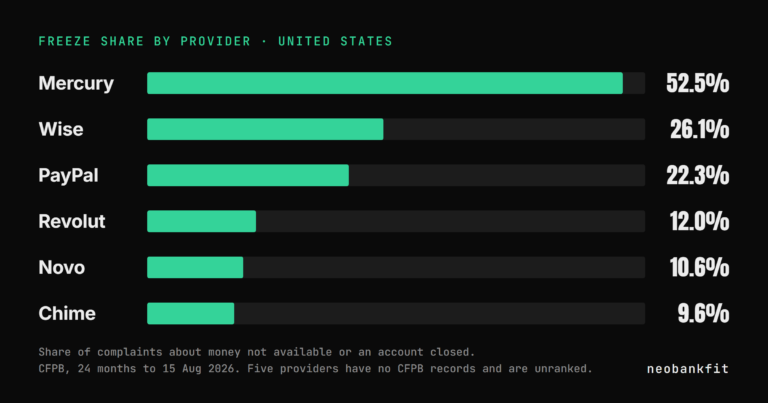
Everything above answers one question: what happens if the company itself fails. It answers nothing about the far more common event, an account that gets frozen while the provider is perfectly solvent. A freeze is not covered by any deposit guarantee or safeguarding scheme, because the company has not failed and your money has not disappeared, it is simply stuck. No compensation claim applies; the only route back is the provider’s complaint process and, if that stalls, escalation to a financial ombudsman or equivalent body in the provider’s licensing jurisdiction.
We broke down that distinction in full, including what actually happens to frozen funds and how the compensation-scheme question gets conflated with it, in is your money safe if a neobank freezes it. If you are dealing with an active freeze right now rather than researching the theory, the practical next step is what to do when your account gets frozen.
How to check what you’re actually using, in about a minute
You do not need to trust a comparison table, including this one, forever. Every regulator with a real banking and payments sector publishes a public register.
- UK: search the firm on the FCA Register and look at its permissions. “Deposit taking” means a bank. “Issuing electronic money” means an EMI.
- EU/EEA: each national regulator (BaFin in Germany, DNB in the Netherlands, CSSF in Luxembourg, and equivalents elsewhere) maintains a similar public register; the provider’s own terms page will usually name the entity and regulator directly, exactly as PayPal’s do.
- Elsewhere: most jurisdictions with an active fintech sector run an equivalent authorised-firm lookup, even where the exact name differs. Mexico’s CNBV publishes the register of IFPE-licensed e-money wallets under Ley Fintech. Singapore’s MAS separates full banks from Major Payment Institutions under the Payment Services Act. Kenya’s central bank publishes which providers, M-Pesa included, are authorised e-money issuers required to hold customer float in trust. The label changes, “e-money issuer,” “payment institution,” “IFPE,” but the underlying question is always the one this article answers: can this entity lend your money, and is it backed by a government guarantee if it fails.
Do not assume from the app icon. One search on the relevant regulator’s register, using the exact legal entity named in the provider’s own terms, tells you in under a minute whether you are holding a bank deposit or a safeguarded e-money balance.
FAQ
Is an EMI less safe than a bank?+–
Not automatically. A bank’s guarantee only exists because it is allowed to lend your money out, which is itself a risk. An EMI cannot lend your money at all and must keep it ring-fenced instead. Both are legitimate structures with different protection mechanisms; the actual risk in an EMI comes from whether the safeguarding was genuinely done, which is exactly what regulators like the FCA are now auditing more aggressively.
Does deposit protection cover a frozen account?+–
No. Deposit guarantees and safeguarding both only pay out if the institution itself fails. A freeze happens while the provider is solvent, so no scheme applies; the only path back is the provider’s complaint process and, if needed, an ombudsman or regulator escalation.
How do I know if my neobank is a bank or an EMI?+–
Check the exact legal entity named in the provider’s terms and conditions, then search that entity on the relevant national regulator’s public register. Look for “deposit taking” (bank) versus “issuing electronic money” (EMI) in its permissions.
Can the same company be a bank in one country and an EMI in another?+–
Yes, and it is common. PayPal’s Luxembourg entity is a licensed bank while its UK entity is an EMI. Revolut has been converting from an e-money entity to a licensed bank market by market rather than everywhere at once. Always check the entity that actually holds your specific account, not the company’s reputation as a whole.
What changed with the FCA’s 2026 safeguarding rules?+–
From 7 May 2026, UK e-money and payment institutions must reconcile safeguarded funds daily, undergo a mandatory annual safeguarding audit, maintain a resolution pack retrievable within 48 hours of a collapse, file monthly regulatory reports, and name one senior manager personally accountable for compliance. A full statutory trust over customer funds was proposed but deferred to a further consultation in 2027 or 2028.
If I live outside the UK, US or EU, does any of this apply to me?+–
The specific numbers differ, but the underlying split does not: almost every jurisdiction with a real fintech sector distinguishes between deposit-taking banks (with a government guarantee) and e-money or payment institutions (with a safeguarding requirement instead). Check your provider’s licensing jurisdiction directly rather than assuming either UK or EU rules apply to your account.
Written by Daniel Hart, who covers neobanks, account freezes and cross-border banking for neobankfit. Based on regulators’ own public disclosures (FCA Register, FCA safeguarding policy statement, Central Bank of Kenya e-money regulations, Mexico’s CNBV/Ley Fintech framework, EU deposit guarantee directive, FSCS and FDIC published limits) and providers’ own terms and regulatory disclosure pages.
This article is general information, not legal or financial advice. Rules, deadlines and protection limits change and depend on your country, account and provider entity. For your situation, check current terms and consider a qualified adviser.